Baseballer Gear

Best Outfield Gloves for Baseball Players in 2026
Discover how to choose the best outfield gloves based on your age, skill level, and budget. Learn what glove size, pocket depth, web style, and leather type work best for tracking fly balls and making secure catches, whether you're a beginner or an experienced player.
7/25/20265 min read


Best Outfield Gloves for Baseball Players
An outfield glove has one job that infield gloves don't have. It needs to help you track down a ball that's been in the air a long time, often at an angle, often with the sun in your eyes. That's why outfield gloves run larger than infield gloves, typically 12 inches to 12.75 inches, with deeper pockets and web styles built to secure the ball once it finally lands in the leather.
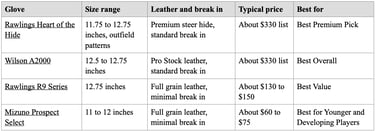
We pulled four outfield gloves that consistently come up across skill levels, from a player just stepping into a real outfield role to an advanced high schooler ready for a pro tier glove. Here's how they compare, and which one actually fits your player.
The Four Gloves at a Glance
Wilson A2000 Is the Best Overall Pick
The A2000 earns best overall here because of how much choice it gives a player without sacrificing quality. Wilson offers outfield A2000s in Dual Post, Single Post, and SuperSkin web variations, all built on the same Pro Stock leather that's held up as an industry standard for decades. A player can find an A2000 pattern that matches their preference, whether that's a deep pocket, a lighter weight, or added durability from the SuperSkin backing, without stepping down in leather quality to get it.
Selection criteria. Look at web style first. Dual Post and Single Post patterns favor a deeper pocket for tracking fly balls. SuperSkin versions shave weight off the glove, which matters over a long game chasing balls in the gaps.
Best use case. An advanced high school or serious travel player who wants one glove they can commit to breaking in and using for multiple seasons, with some flexibility in exactly how it's built.
Limitations. Premium leather still needs real break in time. This isn't a glove you can put into game action right away. And at list price, it's a significant investment for a player who might still be growing into a stable hand size.
Rawlings Heart of the Hide Is the Best Premium Pick
Heart of the Hide is the glove most players recognize by name, and for good reason. It's been Rawlings' flagship line for over 65 years, built from hand selected, pro grade steer hide. The 12.75 inch outfield patterns typically use an H style web or Pro H web, both favored by outfielders for the balance they strike between flexibility and stability when securing the ball.
Selection criteria. At this price point, fit and pattern preference matter as much as brand. Try to handle the specific pattern, such as 302 versus 303, before buying, since Rawlings offers several outfield specific shapes within the Heart of the Hide line.
Best use case. A player who has settled firmly into outfield, is done growing or close to it, and is ready to invest in a glove built to last for years rather than a single season.
Limitations. Nearly identical price point and leather quality to the A2000. The choice between the two often comes down to web pattern preference and brand loyalty more than a meaningful performance gap. It's also worth being clear eyed that a $330 glove is a real commitment, and reviews across retailers on newer colorway releases have been mixed on construction consistency. Verify this against current reviews for the specific model and colorway before publishing this claim.
Rawlings R9 Series Is the Best Value Pick
The R9 Series sits well below Heart of the Hide and A2000 in price while still using full grain leather and offering a 12.75 inch outfield pattern built on Rawlings' 3029 shape with a Pro H web. Rawlings markets it as a game ready glove that needs very little break in, generally described as about 20 percent player break in and 80 percent factory break in, which matters for a player, or a parent's patience, who doesn't want to spend a full offseason working in a new glove.
Selection criteria. Because this line is priced well under the premium options, expect a slightly less premium feel and shape holding ability over the long run compared to Heart of the Hide or A2000. That's a reasonable trade for the price gap, and it's worth noting Rawlings positions the R9 line specifically for select and high school players who want pro style pattern shapes without the premium price tag.
Best use case. A high school or advanced travel player who wants a real upgrade from a youth level glove without spending pro tier money, or a parent who isn't ready to commit Heart of the Hide or A2000 level dollars to a player who's still developing.
Limitations. Full grain leather at this price point doesn't hold its shape over years the way Heart of the Hide's steer hide does. This is a strong multi season glove, not necessarily a decade long one.
We also haven't tested this glove firsthand yet, so this section currently leans on manufacturer specifications rather than hands on experience.
Mizuno Prospect Select Is Best for Younger and Developing Players
We're breaking from a strict overall, value, premium format here because the Prospect Select isn't actually competing with the other three gloves. It's built specifically for younger players, in sizes down to 11 inches, at roughly half the price or less of the R9 Series and a fraction of the price of the premium options above. Mizuno's own product positioning frames it as a step up for a player moving on from a beginner glove, not a budget alternative to a Heart of the Hide.
Selection criteria. Full grain leather and a ButterSoft palm liner give it a more real feel than entry level synthetic gloves, while still keeping break in minimal. That's appropriate for a player who's still developing skills and shouldn't be fighting a stiff glove to make routine plays.
Best use case. A player who has moved into a somewhat regular outfield role but is still growing, both physically and in skill, and doesn't need, or shouldn't have money spent on, a premium adult tier glove yet.
Limitations. This isn't a glove built for the durability demands of daily high level travel ball, and it won't hold a shape or perform at the level of the three gloves above. That's by design, not a flaw. It's solving a different problem for a different player.
How to Choose Between These Four
Still developing, likely to outgrow gloves in the next year or two. Mizuno Prospect Select
Ready for a real upgrade but not ready for pro tier pricing. Rawlings R9 Series
Committed to outfield, ready to invest in a glove that lasts. Wilson A2000 or Rawlings Heart of the Hide, based on web pattern preference
Undecided between the A2000 and the Heart of the Hide. Handle both in person if possible. The difference is largely in web pattern and feel, not a clear performance gap.
Baseballer Gear
Honest baseball equipment reviews from a former college player. Helping parents and players make informed decisions about baseball gear.
Quick links
Contact
© 2026. All rights reserved.
Affiliate Disclosure: Baseballer Gear participates in affiliate programs. When you purchase through links on our site, we may earn a commission at no extra cost to you. This helps support our testing and content creation.